Dan Wang's Breakneck speaks to my childhood and this moment
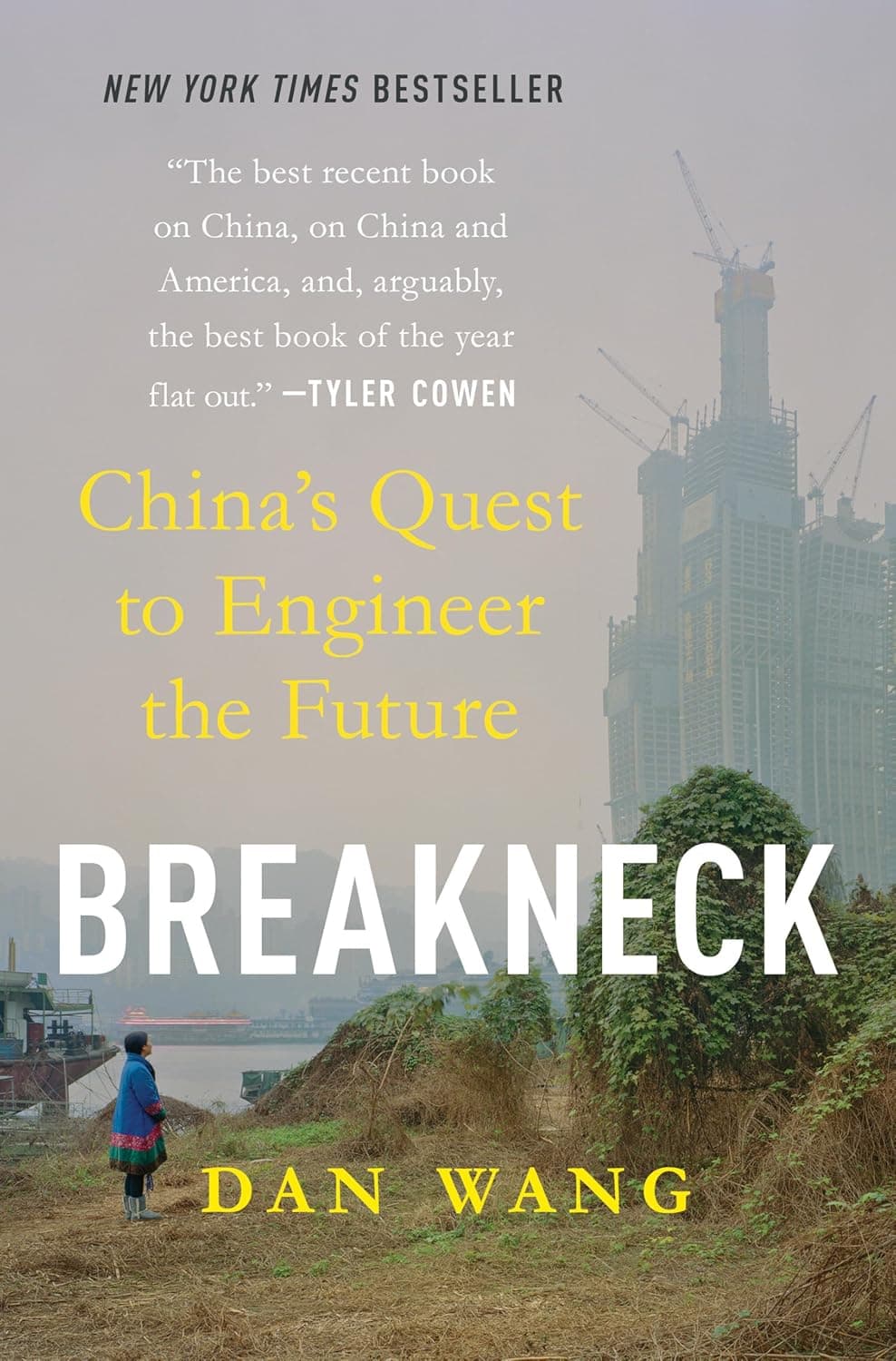
I spend a lot of time trying to explain my very peculiar upbringing, in an American community in the suburbs of Beijing. Dan Wang's 2025 book Breakneck felt both like intellectual catnip and an oddly intimate read. Dan, a Chinese Canadian man, writes about his experiences living in China and experiencing its unfathomable economic development. The centre of his thesis is this idea that the United States and China are more similar than they are different. The key difference, however, is that China is an "Engineering State" and the US is a "Lawyer State". The United States is a country where rule-of-law is the norm and progress happens at the pace of environmental impact assessment and litigation. Change is incremental, but comprehensible. Unfortunately, America's lawyer state nature has cost the country its ability to build and scale technology meaningfully.China, meanwhile, is concerned with industrialisation and engineering efficiency above all else. The corollary of China's engineering prowess is that we don't often consider the human cost of new development.
Dan Wang's crosscultural reflections on living in China feel deeply personal to me. I find this thesis very captivating as a third culture kid who spent much of my childhood in China. Beijing was SimCity 4 at Cheetah Pace growing up. A spaghetti of new subway lines were under construction and new apartment complexes, stadiums and malls were flying up seemingly every week. Even though I spent many of my weekends wandering around the city alone with my camera, I can hardly recognise much of Beijing today.
I spent much of my childhood living underneath a thick layer of PM2.5 smog, beyond hazardous by WHO measurements. Whereas a lawyer state would seek to ban emissions of PM2.5*, an engineering state believes it can build its way out of this conundrum. Every couple months, I load up the Beijing Subway Wikipedia page, eager to see how the subway build is progressing. The Municipal Government set a target to have every resident of Beijing within the 4th Ring Road living a fifteen minute walk away from the subway station. An ambitious target that has been followed with actual, tangible action.
As a civic technologist, my career is dedicated to building modular solutions for government agencies and scaling them out rapidly. The fastest timeframe between when a transit agency signs with Token Transit and when riders can start using our software is three days. Most of that is for legal paperwork to be signed.
On the other hand, procurement for software and hardware can take years! The sales cycle in government outlasts the runway of many small startups. It favours incumbents and makes it harder to streamline government services. I understand that hardware procurement is a big deal and should be done with care, but we should not be measuring the procurement cycle of government in years.
I appreciate Dan's nuanced picture of China, offering not only a picture of the Engineering State at its rosiest, but also at its worst. Walking around Beijing, it's not hard to find examples of injustice where people were in need of protection from rule-of-law. The government can build a subway to your neighbourhood and they can also flatten your ancestral village for a questionable shopping mall.
Overall, I still think that America needs to bias toward streamlining change. One needn't look toward China as an example. One can look toward the State of Victoria in Australia, which continues to cut red tape to make building new housing faster. Even Mayor Mamdani's new administration realises that people voted for structural change and that just going in with a shovel on small quality-of-life improvements creates a sense of momentum for that change.
How might we preserve a strong sense of the rule of law while building a society that moves faster? As a sledgehammer continues to be taken to checks and balances, it's worth taking a moment to think a little more critically about how we're going to build them.
Addendum: A friend co-hosted a fantastic discussion where Chinese and Chinese Americans discussed Breakneck, drawing parallels between Wang's work and their own transnational experiences. It's well worth a read here.